
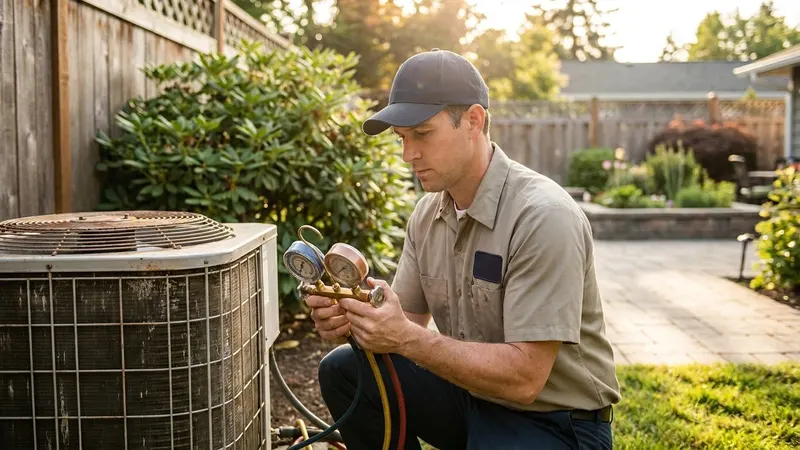
Service your AC once a year, ideally in spring before heavy summer use, and schedule it sooner if you notice warm air, weak airflow, short cycling, or rising utility bills. If those symptoms are already showing up, it may be smarter to book AC repair service instead of waiting for the annual tune-up window. Routine service helps your system cool more efficiently, lowers the chance of a mid-season breakdown, and gives a technician time to catch refrigerant or electrical problems early.
Outside the yearly visit, pay attention to strange noises, uneven cooling, and sudden energy-bill spikes. Those are usually signs your air conditioner needs attention now, not later.
Key Takeaways
- Annual AC servicing in spring prepares your system for peak cooling season
- Regular maintenance saves money on energy bills and prevents costly breakdowns
- Unusual noises, inconsistent cooling, and high energy bills signal the need for AC service
Need AC service in Bellevue?
Reach out if your system is due for maintenance or already showing signs of trouble.
Call (425) 598-0416 Request a QuoteHow to Choose the Right-Size Air Conditioner for Your Space
https://www.youtube.com/watch?v=\_C42hkh6tzY
When choosing the right-sized air conditioner for your space, it’s important to match the unit’s cooling capacity to the size of the room. A 5,000 to 6,000 BTU air conditioner is ideal for spaces up to 250 square feet.
If your room is larger, say between 250 to 400 square feet, a 7,000 to 8,200 BTU unit would work better. For even larger spaces, consider a 9,800 to 12,500 BTU model to efficiently cool areas from 400 to 650 square feet.
To calculate the BTU you need, start by considering the room’s square footage. The Department of Energy recommends 20 BTU per square foot of living space for efficient cooling. For example, a 300-square-foot room needs around 6,000 BTU.
Keep in mind that factors like room exposure, ceiling height, and appliance use may require adjustments to this estimate.
Proper sizing is key for both comfort and energy efficiency. An oversized air conditioner can cool the room too quickly but won’t remove enough humidity, leaving the space feeling clammy. On the other hand, an undersized unit will struggle to cool the area, leading to increased energy use and wear on the system.
Recognizing the Signs for AC Service
I’ve seen my fair share of AC issues over the years. Let’s dive into the telltale signs that your cooling system needs some TLC. Trust me, catching these problems early can save you a bundle.
Warm Airflow and Inadequate Cooling
When your AC starts blowing warm air, it’s time to pay attention. I’ve walked into homes where folks are sweating buckets because their unit isn’t doing its job.
Warm air coming from your vents is a red flag. It could mean low refrigerant levels or a compressor problem. Don’t ignore it!
Another issue I often see is uneven cooling. If some rooms feel like a sauna while others are chilly, your system’s struggling. This can be due to duct problems or a failing compressor.
Keep an eye on your energy bills too. A sudden spike might mean your AC’s working overtime to cool your space. That’s not good for your wallet or your unit’s lifespan.
Weak Airflow and Air Circulation Issues
Weak airflow is like a whisper when you need a shout. It’s frustrating and inefficient. I’ve seen this problem countless times, and it’s often an easy fix.
Poor airflow can be caused by:
- Clogged air filters
- Blocked vents
- Duct leaks
- Blower motor issues
Check your filters first. If they’re dirty, replace ‘em. It’s a simple task that can make a big difference.
If cleaning filters doesn’t help, you might have duct problems. I’ve crawled through many attics fixing leaky ducts. It’s not glamorous, but it’s necessary for proper air circulation.
Don’t forget about your vents. Make sure they’re open and unobstructed. I’ve seen furniture, curtains, and even pet beds blocking airflow.
Unusual Noises During Operation
Strange noises from your AC are like your car making weird sounds - it’s never good news. I’ve heard all sorts of racket from failing units, and each sound can mean something different.
Listen for these noises:
- Banging or clanking: Loose parts
- Squealing: Belt issues or motor problems
- Buzzing: Electrical troubles
- Hissing: Refrigerant leak
Unusual sounds from your compressor are especially concerning. That’s the heart of your system, and if it’s making noise, you need a pro to check it out.
Don’t ignore these sounds. The longer you wait, the worse (and more expensive) the problem can get. I’ve seen small issues turn into major headaches because folks didn’t act fast enough.
Off-Putting Odors and Mustiness
If your AC smells funky, something’s definitely wrong. I’ve walked into homes where the AC was pumping out some nasty odors. It’s not just unpleasant - it can be a health hazard.
Musty smells often mean mold or mildew growth. This can happen when:
- Your unit’s not draining properly
- There’s excess moisture in the system
- The air filter is old and dirty
A burning smell could indicate an electrical problem. That’s serious business and needs immediate attention. I’ve seen melted wires and scorched components that could have led to fires.
If you smell rotten eggs, shut off your system right away. It might be a gas leak, which is dangerous stuff. Call a pro immediately - don’t mess around with this one.
Regular maintenance can prevent most of these odor issues. I always tell homeowners to schedule annual check-ups. It’s cheaper than dealing with a stinky, broken AC later on.
Understanding AC Service Timing
Timing is everything when it comes to AC service. I’ve seen firsthand how proper maintenance can make or break a system. Let’s dive into the nitty-gritty of when to give your AC some TLC.
Seasonal Maintenance for Peak Performance
I always tell homeowners to schedule AC service in spring, before the heat kicks in. This way, you’re not left sweating when summer hits. Here’s my go-to checklist:
- Clean or replace filters
- Check refrigerant levels
- Inspect electrical connections
- Clean condenser coils
I’ve found that spring maintenance catches small issues before they become big, expensive problems. It’s like giving your AC a fighting chance against the summer heat.
Impact of Regular Check-Ins on AC Longevity
In my years on the job, I’ve seen ACs last 15+ years with proper care. Regular maintenance is key. I recommend at least one professional tune-up annually, but twice a year is even better.
Here’s what regular check-ins do:
- Boost efficiency
- Reduce energy bills
- Prevent unexpected breakdowns
I’ve fixed too many units that could’ve lasted longer with routine care. Trust me, the cost of maintenance is a fraction of what you’ll pay for emergency repairs or early replacement.
The Technical Aspects of AC Servicing
When I service an AC unit, I focus on a few key areas that keep it running smoothly. Let’s dive into the nitty-gritty of what I look for to ensure your system stays in top shape.
Checking Refrigerant Levels for Efficient Operation
I always start by checking the refrigerant levels. It’s like the lifeblood of your AC. Too little, and your system struggles to cool. Too much, and it can damage the compressor.
Here’s what I do:
- Measure the pressure in the system
- Compare it to the manufacturer’s specs
- Add or remove refrigerant as needed
If I find a leak, I’ll patch it up right away. Low refrigerant isn’t just bad for cooling - it can lead to frozen coils and higher energy bills. I make sure everything’s just right for peak performance.
Inspecting Electrical Connections for Safety
Next, I take a good look at all the electrical connections. Loose wires can cause big problems, from system failures to electrical fires. I use my trusty multimeter to test:
- Voltage levels
- Amperage draw
- Capacitor function
I tighten any loose connections and replace worn parts. It’s not just about keeping your AC running - it’s about keeping your home safe. I’ve seen too many close calls not to take this seriously.
Cleaning Air Filters to Maintain Air Quality
Clean air filters are crucial for good air quality and efficient operation. A clogged filter makes your AC work harder and can lead to poor indoor air quality.
I always check the filter during a service call. If it’s washable, I’ll give it a good clean. If not, I’ll replace it with a fresh one. I recommend changing or cleaning filters every 1-3 months, depending on use.
Pro tip: Write the date on the filter when you change it. It’s an easy way to keep track.
Clearing the Condensate Drain to Prevent Water Damage
The condensate drain is often overlooked, but it’s vital for preventing water damage. When this line gets clogged, water can back up and cause all sorts of problems.
I clear the drain using:
- Compressed air
- A wet/dry vacuum
- Vinegar solution to kill algae
I also check the drain pan for rust or damage. A little prevention here goes a long way in avoiding costly repairs down the road. Trust me, you don’t want water leaking inside your walls or ceiling.