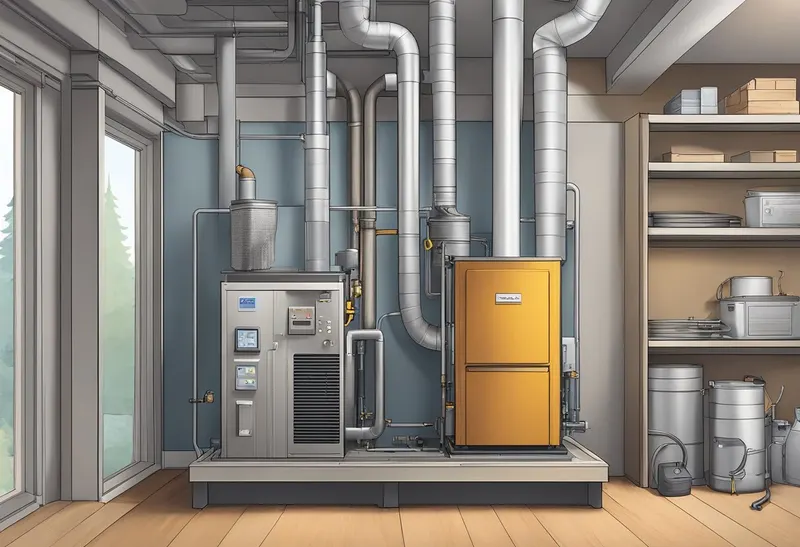
Most furnace repairs land in the $150–$500 range, with national averages clustering around $300 across multiple cost databases. Major component jobs — blower motor, heat exchanger, control board — push that number to $1,000 or more. What you pay depends on which part failed, your local labor rates, and whether you’re calling during business hours or on a January night.
This guide breaks down furnace repair costs by part, explains the diagnostic and labor fees you’ll see on your invoice, and lays out the repair-vs.-replace decision in plain terms.
What Does Furnace Repair Cost Overall?
National averages from major cost databases:
- Angi (March 2026): average $318, range $64–$1,475
- HomeAdvisor (June 2026): average $300, typical range $125–$500
- Forbes Home (June 2025): average $395, typical range $175–$615
- HomeGuide (August 2025): range $50–$1,500
The spread is wide because furnace repair is not a single job — it’s dozens of potential jobs, each with its own parts cost and labor time. A bad igniter is a 30-minute fix; a cracked heat exchanger is a half-day job (or a whole-furnace decision). Both get lumped into the same “furnace repair” search.
For a full picture of home HVAC costs, see our HVAC repair and replacement cost guide.
Furnace Repair Cost by Part
The table below shows installed cost ranges (parts plus labor) for the most common furnace repairs. All figures are national; your area may run higher or lower.
| Part | Typical Installed Range |
|---|
| Hot surface igniter | $100–$500 |
| Flame sensor | $80–$250 |
| Thermocouple | $100–$300 |
| Pressure switch | $150–$400 |
| Limit switch | $100–$375 |
| Capacitor | $80–$450 |
| Control / circuit board | $200–$650 |
| Gas valve | $200–$800 |
| Blower motor (single-speed) | $300–$900 |
| Blower motor (variable-speed) | $600–$1,500+ |
| Draft inducer motor | $200–$1,500 |
| Heat exchanger | $1,000–$3,000 |
Sources: Angi, HomeGuide, Forbes Home.
A few notes on the numbers:
- The igniter range is wide because OEM parts cost more than aftermarket. The job itself is quick; most of the cost is parts.
- Blower motor cost depends heavily on motor type. Variable-speed ECM motors are significantly more expensive to replace than older single-speed models — sometimes $600–$1,500 or more for the part alone before labor.
- Control boards vary by furnace brand and model. A proprietary board from a major manufacturer can run toward the high end of that range.
- The heat exchanger row gets its own section below because the cost and the safety implications are both significant.
Service Call Fees, Labor Rates, and Emergency Pricing
Diagnostic / Trip Fee
Expect a $50–$150 service call fee when a technician comes out to diagnose the problem. Some companies charge $75–$200 for the initial visit (Angi). Most will credit this fee toward the repair if you authorize the work on the spot — ask before they arrive.
Hourly Labor
Residential furnace labor runs $75–$150 per hour nationally (HomeGuide, This Old House). Most straightforward repairs take one to two hours. Larger jobs — blower motor replacement, heat exchanger work — can run three to eight hours.
Emergency and After-Hours Calls
After-hours, weekend, and holiday service costs more. Expect $140–$210 per hour for evening or weekend calls, with holiday rates sometimes reaching $250 or more per hour. If your furnace fails on a Friday night in February, that’s the reality of the market. Keeping up with annual furnace maintenance is the most reliable way to catch failing parts before they strand you in the cold.
The Heat Exchanger: Cost and the Carbon Monoxide Issue
The heat exchanger is the most expensive — and most safety-critical — furnace component to fail. It’s a metal chamber that separates combustion gases from the air circulating through your home. A crack in the heat exchanger means those gases, including carbon monoxide, can enter your living space.
Carbon monoxide is colorless and odorless. Symptoms of exposure include headache, drowsiness, nausea, and shortness of breath — easy to miss or attribute to illness. Energy.gov and manufacturers including Trane and Lennox consistently flag a cracked heat exchanger as a serious safety hazard requiring immediate attention. A visual inspection is not enough to confirm a crack; a qualified technician needs to perform a combustion analysis.
What Does Heat Exchanger Replacement Cost?
Full heat exchanger replacement runs $1,000–$3,000 installed, with a commonly cited average around $1,750 (Angi, HomeAdvisor, HomeGuide). The part alone ranges from $350–$850 for a primary exchanger; labor is $400–$2,150 because the job typically takes four to eight hours.
Repair vs. Replace When the Heat Exchanger Is Cracked
If your furnace is under 10 years old and otherwise in good condition, replacing the heat exchanger is usually the right call. If it’s 10–15 years old or older, get a full-replacement quote first — the heat exchanger job often runs 25–50% of the cost of a new furnace, and you’d be making a large investment in an aging system. At 15 years and up, most contractors (and common sense) lean toward replacement.
A cracked heat exchanger in an older furnace is frequently the deciding factor that tips a repair-vs.-replace decision toward replacement. That’s not an upsell; it’s arithmetic.
Furnace Repair vs. Replace: When Each Makes Sense
The 50% Rule
The most widely cited guideline: if the repair costs more than 50% of a new furnace, replace instead. With installed furnace replacement averaging around $4,800 (This Old House, HomeAdvisor), that 50% threshold works out to roughly $2,400. Spend less than that on a reasonably young furnace, and repair usually wins. Angi suggests the threshold can be as low as 30–50%, depending on age and condition.
The $5,000 Rule
A contractor heuristic that factors in age: multiply the repair cost by the furnace’s age in years. If that product exceeds $5,000, replace. Example: a $600 repair on a 10-year-old furnace = $6,000 → lean toward replacement. The same $600 repair on a 6-year-old furnace = $3,600 → repair makes sense.
Age Threshold
Furnace lifespan consensus is 15–25 years, with manufacturers typically citing 15–20. Once a furnace passes 15 years, each major repair warrants a replacement quote alongside it. The older the unit, the more likely additional components are near end of life — one repair today, another in six months.
| Situation | Likely decision |
|---|
| Furnace under 10 years, small repair | Repair |
| Furnace 10–15 years, repair under $1,500 | Repair, get quote |
| Furnace over 15 years, major repair | Replace |
| Cracked heat exchanger, any age over 10 yr | Get replacement quote |
| Repair cost × age > $5,000 | Replace |
| Repair > 50% of new unit cost | Replace |
How to Keep Furnace Repair Costs Down
Schedule annual maintenance. A tune-up ($125–$200) catches worn igniters, dirty flame sensors, and marginal blower motors before they fail mid-winter. Emergency call rates are real; avoiding them matters. See our guide to HVAC annual maintenance costs for what’s included.
Get at least two quotes for major repairs. For anything over $500 — blower motor, control board, heat exchanger — a second opinion is worth the extra diagnostic fee. Quotes can vary significantly by contractor.
Ask about the diagnostic credit. Most HVAC companies apply the service call fee toward the repair. Confirm this before authorizing the diagnosis.
Replace the filter regularly. A clogged filter strains the blower motor and can trigger the high-limit switch. Both lead to service calls that are entirely avoidable.
Consider repair timing. If a furnace is approaching 15 years and needs a $400 repair, that’s a judgment call worth making — but if the same furnace needs $1,200 in work, it’s time to start pricing replacements rather than pushing the system another winter.
For comparison, if you’re also facing cooling system issues, see our breakdown of AC compressor replacement costs.
Frequently Asked Questions
How much does furnace repair cost?
Most furnace repairs cost $150 to $500, with a national average around $300. Major component jobs like a blower motor or heat exchanger can run $1,000 to $3,000 or more.
Is it worth repairing a furnace or should I replace it?
Repair if the furnace is under 15 years old and the fix costs less than half of a new unit. Replace if it is past 15 years, the heat exchanger is cracked, or repair cost times age exceeds $5,000.
Why is a cracked heat exchanger so serious?
A cracked heat exchanger can leak carbon monoxide, a colorless and odorless gas, into your home. It almost always means replacing the heat exchanger or the whole furnace on safety grounds.
What does a service call or diagnostic fee cost?
Most technicians charge a $50 to $150 diagnostic or trip fee. Many will credit that amount toward the repair if you proceed with the work.
How long does a furnace last?
Most furnaces last 15 to 25 years. Units past 15 years that need an expensive repair are usually better candidates for replacement than continued repair.